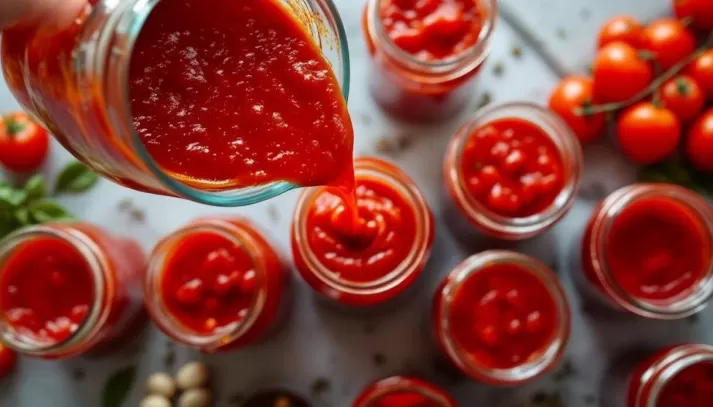
Tomato sauce production on a small-to-medium scale, in agritourism businesses, artisanal preserve workshops and farms with in-house processing, comes with well-known pitfalls. Washing, blanching, milling, cooking and packaging often require separate stations, with dead time between each step and inconsistent quality control.
One of the biggest challenges is standardization. With traditional methods, the recipe varies from batch to batch, cooking times are never quite the same, and there’s no traceability of process parameters — a serious problem for anyone who needs to prove regulatory compliance, especially for export.
The Coveser Multipurpose Workstation was designed to eliminate this variability and turn tomato sauce production into a repeatable, traceable and scalable process. In a single system it handles cooking, vacuum concentration and heat treatment (pasteurization or sterilization, depending on the desired shelf life). Upstream and downstream phases such as washing, blanching and milling are carried out by auxiliary equipment that integrates into the same line.
Traceability is built in: the parameters of every cycle (temperature, process time, pasteurization curve) are recorded and can be exported via USB, so every batch is documented for inspections and foreign markets.
Problems the Multipurpose Workstation solves in tomato sauce production
- Process fragmentation: moving from one machine to another (cooker, concentrator, pasteurization unit) increases dead time and the risk of contamination between stages. The Multipurpose Workstation brings cooking, concentration and heat treatment together in one system.
- Heat loss: in non-integrated systems the product cools down and must be reheated between stages, losing color stability and using more energy.
- Yield variability: manual milling or uncalibrated machines generate non-optimized skin and seed waste, losing usable pulp. For this phase Coveser provides auxiliary equipment that integrates into the same line.
- Space and investment: for a small business, buying separate production lines means more floor space and more capital tied up compared to a single compact solution
How much time is lost in tomato sauce production without a Multipurpose Workstation?
With separate machinery, every product transfer between stations means waiting time, manual handling and machine re-setting. The result is repeated setup times, extra labor to move the product and longer production cycles for the same output.
With a Multipurpose Workstation, cooking, concentration and heat treatment happen in sequence at the same station. This eliminates dead time and keeps the product in a continuous flow, with a direct benefit on the shelf life of the finished product. Recipes saved on the 10-inch touchscreen also make every batch repeatable, so tomato sauce production no longer depends on the judgment of the individual operator.
The importance of vacuum cooking and concentration in tomato sauce production
Vacuum processing lowers the tomato’s boiling point, allowing the sauce to be cooked and concentrated without the high temperatures that would otherwise compromise color and flavor. The final product keeps a fresher, more natural taste, with an aromatic profile closer to raw tomato than a traditional, prolonged cooking process would give.
Scraper blades keep the sauce in constant motion throughout the cycle. This prevents it from sticking to the bottom of the tank and eliminates the risk of scorching that would alter the flavor of the finished product. To choose the right heat treatment for your product, read our guide on pasteurization vs sterilization.
One machine, multiple products beyond tomato sauce production
Tomato sauce producers rarely make just one product. The Multifunction Workstation lets you switch from sauce to a ready-made pasta sauce, a vegetable preserve, or a jam without changing machinery — simply recall the saved recipe on the system. For higher volumes or parallel batch production, dual independent tank configurations (35,50 o 100 liters) are available, allowing cooking and pasteurization to run in real time on two batches at once. Steam or electric heating adapts to the energy resources already present in your plant.
For a complete overview of how the multi-function bench works and all the processes it handless, see Multipurpose Workstation : The Complete Guide to Food Processing.
Complete Turnkey Solution
The Multipurpose Workstation takes care of the actual food processing: cooking, vacuum concentration, candying and heat treatment. For the phases that come before and after it, Coveser provides auxiliary equipment that integrates into the same line, supplying complete turnkey workshops.
Why to choose Coveser Multipurpose Workstation?
If production varies throughout the year, the Multipurpose Workstation proves to be the most effective answer: a single plant capable of adapting to different processes, without changing the production workflow or having to invest in additional machines. The Coveser Multipurpose Workstation brings together vacuum cooking, concentration, candying, and sterilization/pasteurization in a single machine. A solution designed for those who want to grow in volume without sacrificing the artisanal quality of the product.
What production capacity does the Multipurpose Workstation have?
The Coveser multifunction unit is available in different models depending on customer needs. It features either a single tank or independent double tanks. The two tanks can work in parallel increasing output without the need for additional machines.
What heating options are available?
The machine is available in steam or electric versions, allowing it to adapt to the energy resources already available on-site and optimize operating costs.
Is the Multipurpose Workstation suitable for small labs, or only for industrial production?
It is designed for a wide range of settings: artisanal labs, small food industries, and R&D departments. The ability to save recipes and recall them for every production run makes it suitable even for businesses without a dedicated technical team, since it eliminates the variability tied to individual operator sensitivity.
How much does a Coveser Multipurpose Workstation cost?
The price varies depending on the configuration (tank capacity, heating type, requested options). For a customized quote based on your production volumes, you can request a quote directly from the product page or contact the Coveser team for a free consultation.
How do I know which Multipurpose Workstation configuration is best suited to my production?
Coveser can identify the most suitable configuration by analyzing with you the quantity of product per cycle, the type of processing, the number of tanks, the heat treatment required (pasteurization or sterilization) and the space available in your workshop. For the full specifications of each version, you can consult the technical data sheets of the individual models, available at the top of the page.
Request a free consultation
To find out which configuration best suits your volumes and products.